
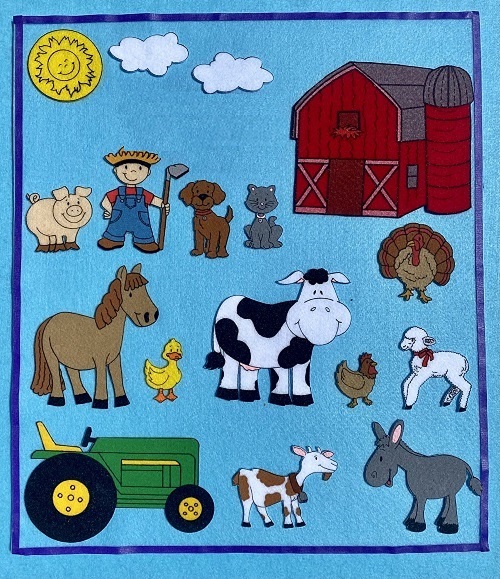
 Pass out flannel board pieces of fam animals. Play or sing "Old Macdonald Had a Farm" . When a child hears the animal he/she is holding, that child comes up to place the animal piece on the flannel board.Early Literacy Aside--Example: Having your children hear and make the sounds of the animals is one enjoyable way to help them develop phonological awareness, to eventually be able to hear the smaller sounds in words.
Take-Home Activity: Hand out shapes of animals for families to take home.
Early Literacy Aside--Empower: Parents, you can use these animal shapes to make animal sounds with your children and home and sing the song with them to practice the skill of phonological awareness.
Pass out flannel board pieces of fam animals. Play or sing "Old Macdonald Had a Farm" . When a child hears the animal he/she is holding, that child comes up to place the animal piece on the flannel board.Early Literacy Aside--Example: Having your children hear and make the sounds of the animals is one enjoyable way to help them develop phonological awareness, to eventually be able to hear the smaller sounds in words.
Take-Home Activity: Hand out shapes of animals for families to take home.
Early Literacy Aside--Empower: Parents, you can use these animal shapes to make animal sounds with your children and home and sing the song with them to practice the skill of phonological awareness.
Submitted by Helen Patzer, Dayton (OH) Metro Library, Northtown-Shiloh Branch.
 I fed my duck under yonder tree.
Duck goes quack, quack,
Cat goes fiddle-i-fee.
Keep adding verses one-by-one:
Bought me a dog and the dog pleased me,
I fed my dog under yonder tree.
Dog goes bow-wow, bow-wow,
Horse goes neigh, neigh,
Cow goes moo, moo,
Pig goes oink, oink,
Sheep goes baa, baa,
Goose goes hissy, hissy,
Duck goes quack, quack,
Cat goes fiddle-i-fee.
Early Literacy Aside--Example: This song includes some silly animal sounds which is the beginning of making the child aware of the sounds within words.
I fed my duck under yonder tree.
Duck goes quack, quack,
Cat goes fiddle-i-fee.
Keep adding verses one-by-one:
Bought me a dog and the dog pleased me,
I fed my dog under yonder tree.
Dog goes bow-wow, bow-wow,
Horse goes neigh, neigh,
Cow goes moo, moo,
Pig goes oink, oink,
Sheep goes baa, baa,
Goose goes hissy, hissy,
Duck goes quack, quack,
Cat goes fiddle-i-fee.
Early Literacy Aside--Example: This song includes some silly animal sounds which is the beginning of making the child aware of the sounds within words. Submitted by Anna Hancock, Cincinnati (OH) Public Library
 There for all to see.
You may blow one candle out,
There for all to see.
You may blow one candle out, 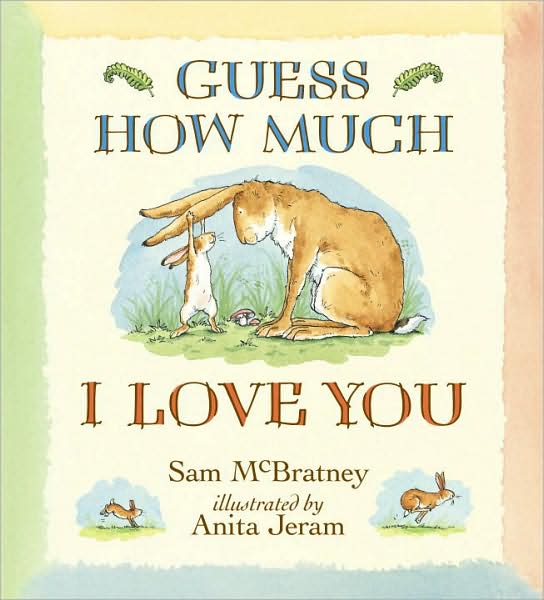 Our next book is Guess How Much I Love You by Sam McBratney.Early Literacy Aside--Example: This is my favorite book from my son's early years. We would read this one every night and we both knew the book word for word. Having a positive interaction with books and reading is an example of print motivation, helping children to associate reading with enjoyment.
Submitted by Karri Marshall, Lane (OH) Public Libraries
Our next book is Guess How Much I Love You by Sam McBratney.Early Literacy Aside--Example: This is my favorite book from my son's early years. We would read this one every night and we both knew the book word for word. Having a positive interaction with books and reading is an example of print motivation, helping children to associate reading with enjoyment.
Submitted by Karri Marshall, Lane (OH) Public Libraries To look in a birds nest; then there were three.
Three little kittens wondered what to do.
One saw a mouse, and then there were two.
Two little kittens playing near a wall.
One little kitten chased a red ball.
One little kitten with fur soft as silk,
Left all alone to drink a dish of milk.
To look in a birds nest; then there were three.
Three little kittens wondered what to do.
One saw a mouse, and then there were two.
Two little kittens playing near a wall.
One little kitten chased a red ball.
One little kitten with fur soft as silk,
Left all alone to drink a dish of milk.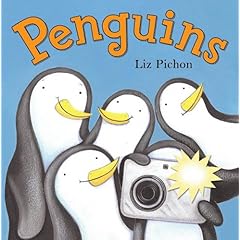 [New words in this book: activities, camera lens, grinning, waddle, amazing, developed]Listen to the interesting words in this book as I read it.
Read the book.
Early Literacy Aside--Example: Hearing new words in books helps your child learn lots of words and the more vocabulary they learn the more they will understand what they will read.
[New words in this book: activities, camera lens, grinning, waddle, amazing, developed]Listen to the interesting words in this book as I read it.
Read the book.
Early Literacy Aside--Example: Hearing new words in books helps your child learn lots of words and the more vocabulary they learn the more they will understand what they will read.
 Early Literacy Aside--Explain: We are going to have fun playing with sounds today, reading stories with sound words. Playing with sounds helps develop phonological awareness which will help your child learn to hear the smaller sounds in words.Read book emphasizing sound words like crunch and munch. Then I go back to some pages and have the children say the words with me, again emphasizing different sounds.
Early Literacy Aside--Example: Hearing and learning sound words like splish-splash is an enjoyable way of learning phonlogical awareness and will help your children later hear smaller sounds in words.
Early Literacy Aside--Empower: At home, play with sound words, like splish-splash in the bath, crunch-munch at snack, and exaggerate how you are saying words to practice hearing their parts.
Early Literacy Aside--Explain: We are going to have fun playing with sounds today, reading stories with sound words. Playing with sounds helps develop phonological awareness which will help your child learn to hear the smaller sounds in words.Read book emphasizing sound words like crunch and munch. Then I go back to some pages and have the children say the words with me, again emphasizing different sounds.
Early Literacy Aside--Example: Hearing and learning sound words like splish-splash is an enjoyable way of learning phonlogical awareness and will help your children later hear smaller sounds in words.
Early Literacy Aside--Empower: At home, play with sound words, like splish-splash in the bath, crunch-munch at snack, and exaggerate how you are saying words to practice hearing their parts.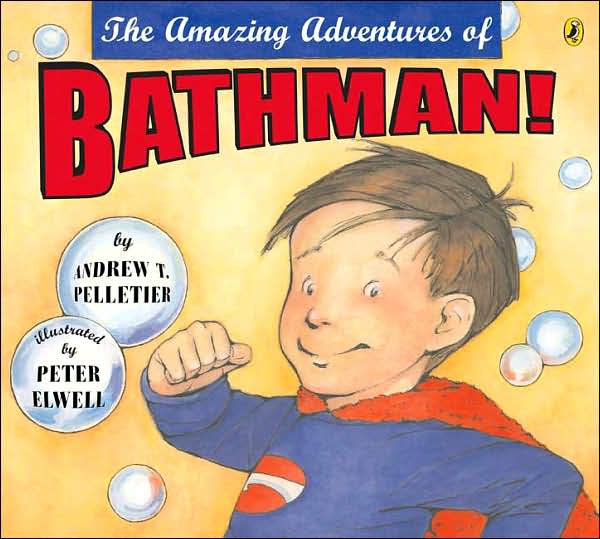 Book Introduction: Start with book upside down. Children will say to "turn it the right way". If not, look at the upside-down book and say, "Oh I can't read it like this, I have to turn it right side up. Read title and point out author/illustrator, running finger under the words.
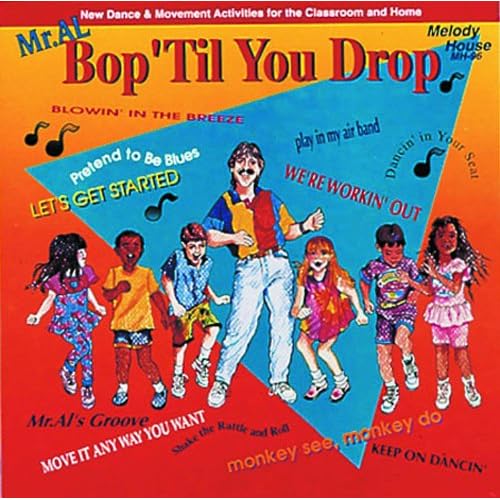 Early Literacy Aside--Explain: Research shows that there are early literacy skills that influence a child's ability to learn to read. Today, you will probably notice several places where I demonstrate examples of narrative skills, which is the ability to describe things and events and to tell stories. When you develop this skill, it will help your children understand what they reads later.Song: Bop 'Til You Drop
Go through the sequence of motions that are in the song, Bop 'Til You Drop
Early Literacy Aside--Example: Singing songs that have a certain order is one great way for children to remember the sequence or order of things. They will use the same skill when they retell a story. They learn how stories work.
Early Literacy Aside--Empower: One thing that you can do at home to develop narrative skills is to describe regular activities such as taking a bath--"first we'll get out the towel, then we'll put the water in the tub and add the bubbles/toys, then we'll take off your clothes, and get in the water. We can scrub our toes, our ears . . . " With older kids, let THEM describe the sequence of events with prompts like, "What do we have to do before we put the bubbles in? or "What do we do next?"
Early Literacy Aside--Explain: Research shows that there are early literacy skills that influence a child's ability to learn to read. Today, you will probably notice several places where I demonstrate examples of narrative skills, which is the ability to describe things and events and to tell stories. When you develop this skill, it will help your children understand what they reads later.Song: Bop 'Til You Drop
Go through the sequence of motions that are in the song, Bop 'Til You Drop
Early Literacy Aside--Example: Singing songs that have a certain order is one great way for children to remember the sequence or order of things. They will use the same skill when they retell a story. They learn how stories work.
Early Literacy Aside--Empower: One thing that you can do at home to develop narrative skills is to describe regular activities such as taking a bath--"first we'll get out the towel, then we'll put the water in the tub and add the bubbles/toys, then we'll take off your clothes, and get in the water. We can scrub our toes, our ears . . . " With older kids, let THEM describe the sequence of events with prompts like, "What do we have to do before we put the bubbles in? or "What do we do next?" Ten little campers make a ring. (Form circle putting tips of fingers together and thumbs together)
Ten little campers start to sing. (Cup hands to mouth)
Ten little campers around the fire. (Form circle putting tips of fingers together again)
Ten little campers dance till they tire. (Put all ten fingers up in the air and dance them around)
Ten little campers say good-night. (Wave good-night with both hands)
Ten little campers close their tent up tight. (Intertwine fingers together again to signify closure)
Early Literacy Aside--Example: Rhymes are fun to sing and say with your child. Because they rhyme, they also help children develop phonological awareness, an important skill for later reading when they try to sound out words.
Ten little campers make a ring. (Form circle putting tips of fingers together and thumbs together)
Ten little campers start to sing. (Cup hands to mouth)
Ten little campers around the fire. (Form circle putting tips of fingers together again)
Ten little campers dance till they tire. (Put all ten fingers up in the air and dance them around)
Ten little campers say good-night. (Wave good-night with both hands)
Ten little campers close their tent up tight. (Intertwine fingers together again to signify closure)
Early Literacy Aside--Example: Rhymes are fun to sing and say with your child. Because they rhyme, they also help children develop phonological awareness, an important skill for later reading when they try to sound out words. Early Literacy Aside--Example: Having your child say a repeated phrase with you throughout the book keeps him involved. This is a great way to keep your booksharing time fun and it supports print motivation--that enjoyment of reading. Participation keeps them interested.Read Bear Wants More and have the children chime in with the repeated phrase.
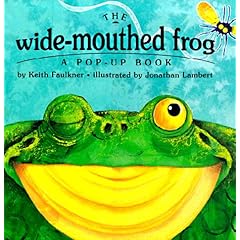 Early Literacy Aside--Example: Print motivation is an interest in and enjoyment of books. Children need this skill prior to formal reading instruction. One way to develop this skill is to use pop-up books and other books that provide surprises. Let's see what surprises this book brings.Read Wide-Mouthed Frog.
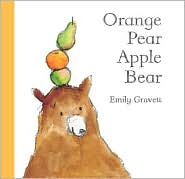 Early Literacy Aside--Example: When you choose books for your children, they like the ones that have pictures of things that are familiar to them. So, here is one with a picture of an apple. You can talk about the apple in the picture, its color, its shape. Then get a real apple and show it to your child. Talk about how it tastes--sweet, how it feels--round and smooth, the sound it makes when you bite it--CRUNCH!By showing your child the real object, you are helping them realize that pictures represent real things. Later they will also understand that printed words represent real things as well. This develops print awareness. I'll read this story to you once, then we'll use the flannel board to tell it again!
Read Orange Pear Apple Bear by Emily Gravett
Early Literacy Aside--Example: When you choose books for your children, they like the ones that have pictures of things that are familiar to them. So, here is one with a picture of an apple. You can talk about the apple in the picture, its color, its shape. Then get a real apple and show it to your child. Talk about how it tastes--sweet, how it feels--round and smooth, the sound it makes when you bite it--CRUNCH!By showing your child the real object, you are helping them realize that pictures represent real things. Later they will also understand that printed words represent real things as well. This develops print awareness. I'll read this story to you once, then we'll use the flannel board to tell it again!
Read Orange Pear Apple Bear by Emily Gravett