Jack and Jill Rhyme and Song

February 11, 2012 on 8:39 am | In 0 to 2, 2's and 3's, 4's and 5's, Adult Aside, Age Levels, Fingerplays and Rhymes, Music/Songs, Phonological Awareness, Practices, Storytime Component, Uncategorized | No Comments

Nursery Rhyme: Jack and Jill
Jack and Jill went up the hill
To fetch a pail of water
Jack fell down
And broke his crown
And Jill came tumbling after.
Preparation: Have the words to the rhyme up on a chart. Have the group say, not sing, the words. Then have the group sing the rhyme. Ask the adults what differences they noticed when singing it vs. saying it.
Early Literacy Aside: Singing slows down language so that children can hear the smaller sounds in words. This helps children later to sound out the words when they learn to read.

Share on Social Media

A Rhyming We Will Go

September 22, 2011 on 11:34 pm | In 4's and 5's, Adult Aside, Age Levels, Crafts/Activities, Music/Songs, Phonological Awareness, Storytime Component | No Comments

Early Literacy Aside:  You can play this little game any place, any time you are with your children–in the car, waiting in line, at the doctor’s office. These little things you do all add up to make a difference in helping your child be ready to learn to read. When you help them hear and make rhymes, you are helping your child develop phonological awareness, hearing the smaller sounds in words so they can later sound out words when they learn to read.

To the tune of A Hunting We Will Go
A rhyming we will go
We’ll catch a rhyme
In the nick of time
And this is how it goes.

Now pick a word and see if the children can make a rhyming word.

Repeat as often as you like. Remember, rhyming words can be nonsense words!

Share on Social Media

Old Macdonald using sounds

September 22, 2011 on 11:30 pm | In 2's and 3's, 4's and 5's, Adult Aside, Age Levels, Music/Songs, Phonological Awareness, Storytime Component | No Comments

Early Literacy Aside: Helping children hear the beginning sounds of words is one way to develop their phonological awareness–their ability to hear the smaller sounds in words. This will later help them sound out words when they learn to read. You can put new words to the tune of the song Old Macdonald. I’ll say two words and you see if you can hear the beginning sound which is the same for both words. SSSSSad and SSSSSSilly. What’s the sound that is the same for both words? Right! /s/ Now we’ll sing a song about it. Let’s try it. 
To the tune of Old
Macdonald Had a Farm
What’s the sound that these words share?
Listen to these words:
Sad and silly are these words
Tell me what you heard.
With a /s/, /s/, here and a /s/, /s/ there|
Here a /s/, there a /s/, everywhere a /s/, /s/
/
S/ is the sound that these words share.
We can hear the sound!

Try other words and sounds. It is easier for the children to join in with the sounds if you talk about the words before singing the song.

Share on Social Media

A Tisket a Tasket

September 22, 2011 on 11:22 pm | In 4's and 5's, Adult Aside, Music/Songs, Phonological Awareness, Storytime Component | No Comments

 Early Literacy Aside: We just read a book with rhyming words and then went back to a page and talked about the rhyming words. In order to emphasize rhyming words, here is a song you can sing after you and your child have talked about two rhyming words. So let’s say you have noticed that ball and tall rhyme. Here’s the song.This helps develop your child’s phonological awareness, being able to hear the smaller sounds in words.
A tisket a tasket
Let’s make a rhyming basket
Boy and toy share an ending sound.
Rhming words are all around!

Share on Social Media

Pop Goes Pre-Reading

March 2, 2011 on 12:08 pm | In 0 to 2, 2's and 3's, 4's and 5's, Adult Aside, Age Levels, Introduction, Letter Knowledge, Narrative Skills, Phonological Awareness, Print Awareness, Print Motivation, Storytime Component, Vocabulary | No Comments

Song for Introductory Skill 
To the tune of Pop Goes the Weasel
Our early literacy skill today
is letter knowledge [fill in the name of the skill].
Getting to know lots of shapes [Substitute aspect of skill being highlighted]
will HELP children read.

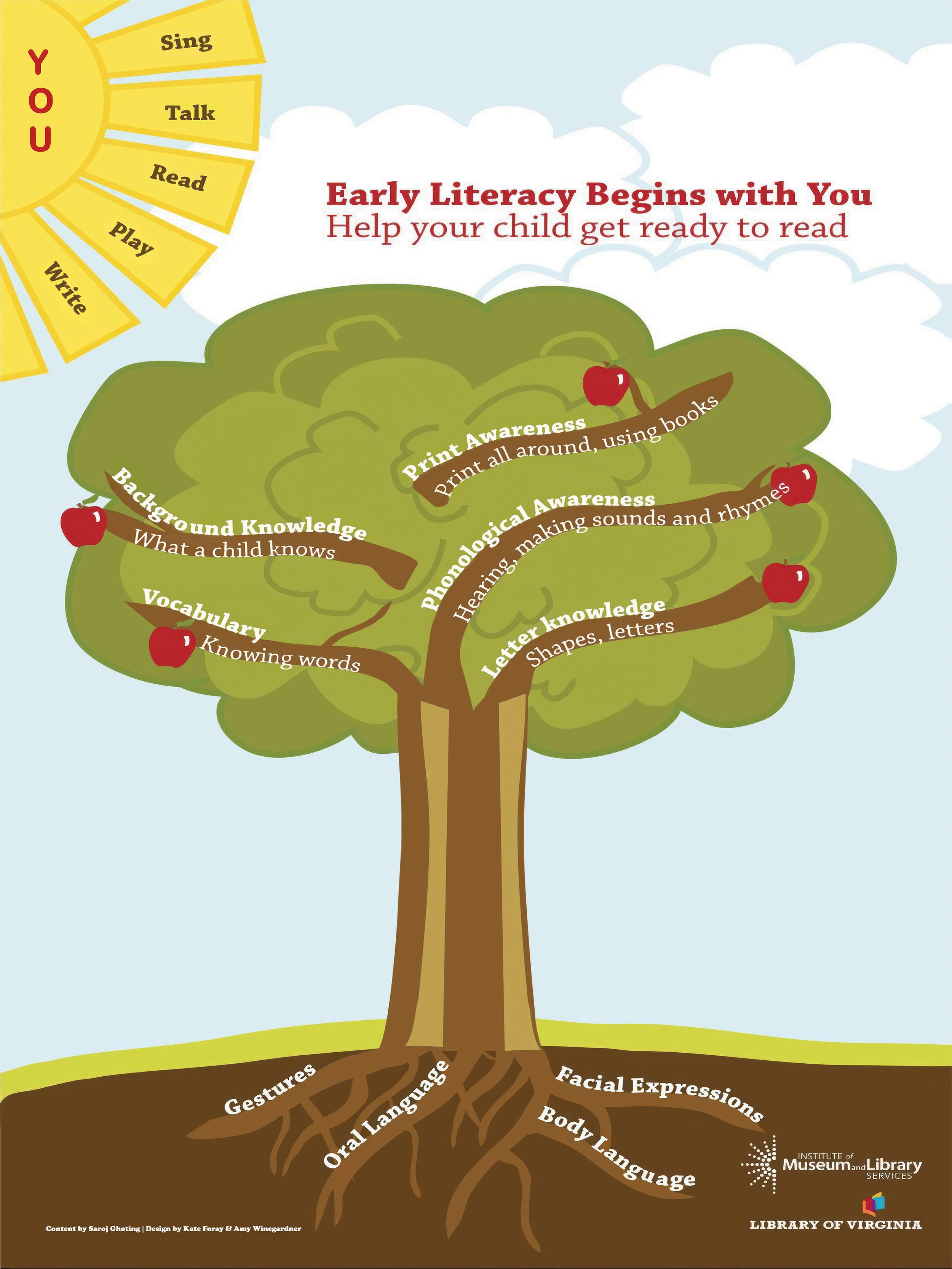
Add information related to skill: Researchers have found that children recognize letters according to their shapes.  Talking with young children about shapes is one way to support emerging literacy skills.

Share on Social Media

Videoclip of Hickory Dickory Dock–Interaction

January 29, 2011 on 8:40 am | In 2's and 3's, 4's and 5's, Adult Aside, Age Levels, Fingerplays and Rhymes, Movement Activities, Storytime Component | No Comments

Videoclip of making Hickory Dickory Dock more interactive between adults and children.
http://www.youtube.com/watch?v=KGF8MhcF9uM 

Share on Social Media

Videoclip of Introductory Aside using Host Puppet

January 29, 2011 on 8:24 am | In 0 to 2, 2's and 3's, 4's and 5's, Adult Aside, Age Levels, Introduction, Storytime Component, Vocabulary | No Comments

To view a videoclip of using a host puppet to convey early literacy information in an introductory aside during storytime, click here: http://www.youtube.com/watch?v=CvZr8i_25_E 

Share on Social Media Share on Social Media

ABC Look at Me by Roberta Intrater

May 12, 2010 on 8:36 pm | In 2's and 3's, 4's and 5's, Adult Aside, Age Levels, Books, Letter Knowledge, Storytime Component | No Comments

Introductory Aside: Noticing that the same letter can look different, like upper and lower case, is a beginning step for letter knowledge, one of the six early literacy skills that children need to be able to learn to read. 
Early Literacy Aside: One way we can help children learn what the letters look like and the letter names is by sharing alphabet books. When sharing alphabet books with children, we tend to focus more on the print than with any other type of book. Let’s share an alphabet book together.
Share the book ABC Look at Me  by Roberta Intrater. 
Did you notice that when I read the book, I pointed to the letter? As we read alphabet books, we tend to point out the letter on the page as we say its name. This does not come so naturally while reading other kinds of books. As you talk about the letter you can point out that the same letter can look different. For example, here’s the letter R. It can look like R or r.
Closing Aside: When you read alphabet books, don’t worry if your child does not recognize the letters and the different ways they look. You are just introducing the idea that the same letter can look different. Alphabet books do not need to be read from A to Z. You can give the book to your child and let them choose a page that looks interesting. Then talk about the picture and the letter. As your child grows, keep pointing out and talking about letters. Let your child see your interest in them and they will follow your lead in learning them.

Share on Social Media

Goodnight Max by Rosemary Wells

May 12, 2010 on 7:46 pm | In 0 to 2, 2's and 3's, Adult Aside, Age Levels, Books, Letter Knowledge, Storytime Component | No Comments

Introduction: Let’s look at the cover of this book Goodnight Max by Rosemary Wells. What shapes do you see? Yes, the blanket has colored squares, the moon is a crescent shape; Max’s nose looks like a triangle.
Read the book.
Early Literacy Aside: You don’t need a book about shapes to talk about shapes. Talking about shapes with your child as we did at the beginning of this book, is the beginning of being able to recognize letters. Children begin to recognize letters by their shapes.

Share on Social Media Next Page »

Powered by WordPress with Pool theme design by Borja Fernandez.
Entries and comments feeds. Valid XHTML and CSS. ^Top^