
Introduction to flannel board: Let's see what happens when you fill the tub with water. What might we see in the bathtub? Each line starts with "Fill the tub with water, what do you see?" Let's say that together. . . . Good!
Fill the tub with water, what do you see? I see bubbles floating in the bathtub sea. Fill the tub with water, what do you see? I see a washcloth floating in the bathtub sea. Fill the tub with water, what do you see? I see a cake of soap floating in the bathtub sea. Fill the tub with water, what do you see? I see a shampoo bottle floating in the bathtub sea. Fill the tub with water, what do you see? I see a little boat floating in the bathtub sea. Fill the tub with water, what do you see? I see a pouring cup floating in the bathtub sea. Fill the tub with water, what do you see? I see a toy shark floating in the bathtub sea. Fill the tub with water, what do you see? I see some swim goggles floating in the bathtub sea. Fill the tub with water, what do you see? I see a watering can floating in the bathtub sea. Fill the tub with water, what do you see? I see a rubber ducky floating in the bathtub sea. Fill the tub with water, what do you see? I see a nice clean baby splashing in the bathtub sea.
Early Literacy Aside--Empower: Even when you are giving your children a bath, naming the objects, describing them, talking about floating and sinking, heavy and light, as they play with toys in the bath; these are good ways to expand their knowledge and vocabulary which will later help them understand what they read.
by Amy Alapati and Virginia Krute, Montgomery County (MD) Public Library Flannel board pattern: filltubwaterFB

 Early Literacy Aside--Explain: Hello, parents. Today in storytime we are highlighting one of the early literacy skills, phonological awareness. This is the ability to hear and play with the smaller sounds in words including rhyming, beginning sounds and today we'll be doing animal sounds. Developing this skill will help children later sound out words as they learn to read.As you read Cock-a-Moo-Moo, note when the rooster crows that the font is large which means to use a LOUD voice. Point out the words for the corresponding sounds. Conclude the story by having the children say cock-a-doodle-do loudly to convey the rooster getting it right.
Early Literacy Aside--Example: Hearing and learning animal sounds helps children hear the smaller sounds in words too.
Early Literacy Aside--Empower: Hearing the rhythm of language and making the sounds of animals, both of these contribute to phonological awareness, hearing the smaller sounds in words, one of the skills that researchers have found helps with reading later on. Take opportunities during the course of the day to point out and to imitate sounds you hear, a car horn, the doorbell ringing, and so forth.
Early Literacy Aside--Explain: Hello, parents. Today in storytime we are highlighting one of the early literacy skills, phonological awareness. This is the ability to hear and play with the smaller sounds in words including rhyming, beginning sounds and today we'll be doing animal sounds. Developing this skill will help children later sound out words as they learn to read.As you read Cock-a-Moo-Moo, note when the rooster crows that the font is large which means to use a LOUD voice. Point out the words for the corresponding sounds. Conclude the story by having the children say cock-a-doodle-do loudly to convey the rooster getting it right.
Early Literacy Aside--Example: Hearing and learning animal sounds helps children hear the smaller sounds in words too.
Early Literacy Aside--Empower: Hearing the rhythm of language and making the sounds of animals, both of these contribute to phonological awareness, hearing the smaller sounds in words, one of the skills that researchers have found helps with reading later on. Take opportunities during the course of the day to point out and to imitate sounds you hear, a car horn, the doorbell ringing, and so forth.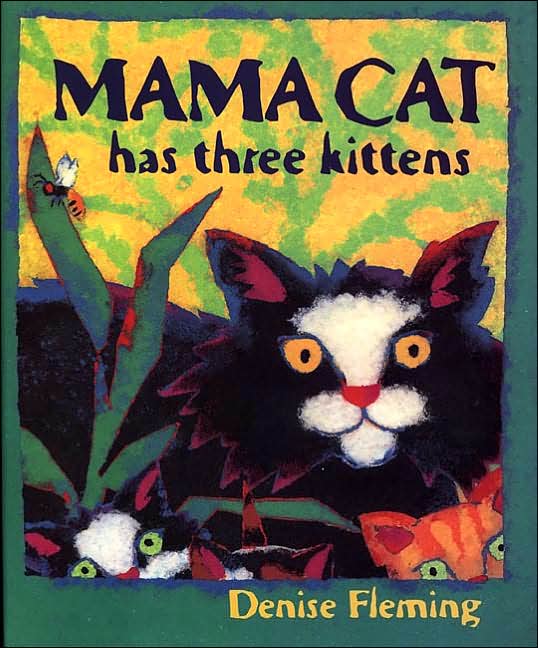 Cat Puppet: There's a cat in my hat, a cat in my hat, a cat in my hat today (do twice). What does the kitty cat say? [cat puppet says meow]Read Mama Cat Has Three Kittens
Early Literacy Aside--Example: When children hear rhymes, rhythms and sounds of animals, it helps them develop phonological awareness, hearing the smaller sounds in words. This is a skill that will help them as they begin to read.
Early Literacy Aside--Empower: Keep doing rhymes with things in your children's world. Today we did cat in my hat. You can do ball in the hall or star on my car (give a star sticker).
Cat Puppet: There's a cat in my hat, a cat in my hat, a cat in my hat today (do twice). What does the kitty cat say? [cat puppet says meow]Read Mama Cat Has Three Kittens
Early Literacy Aside--Example: When children hear rhymes, rhythms and sounds of animals, it helps them develop phonological awareness, hearing the smaller sounds in words. This is a skill that will help them as they begin to read.
Early Literacy Aside--Empower: Keep doing rhymes with things in your children's world. Today we did cat in my hat. You can do ball in the hall or star on my car (give a star sticker).